CID Lab Consult
After having decided the technical interaction that I want to form the basis of my website, I approached Andreas to ask for help on implementing it into my website. This was the reference that I showed him.

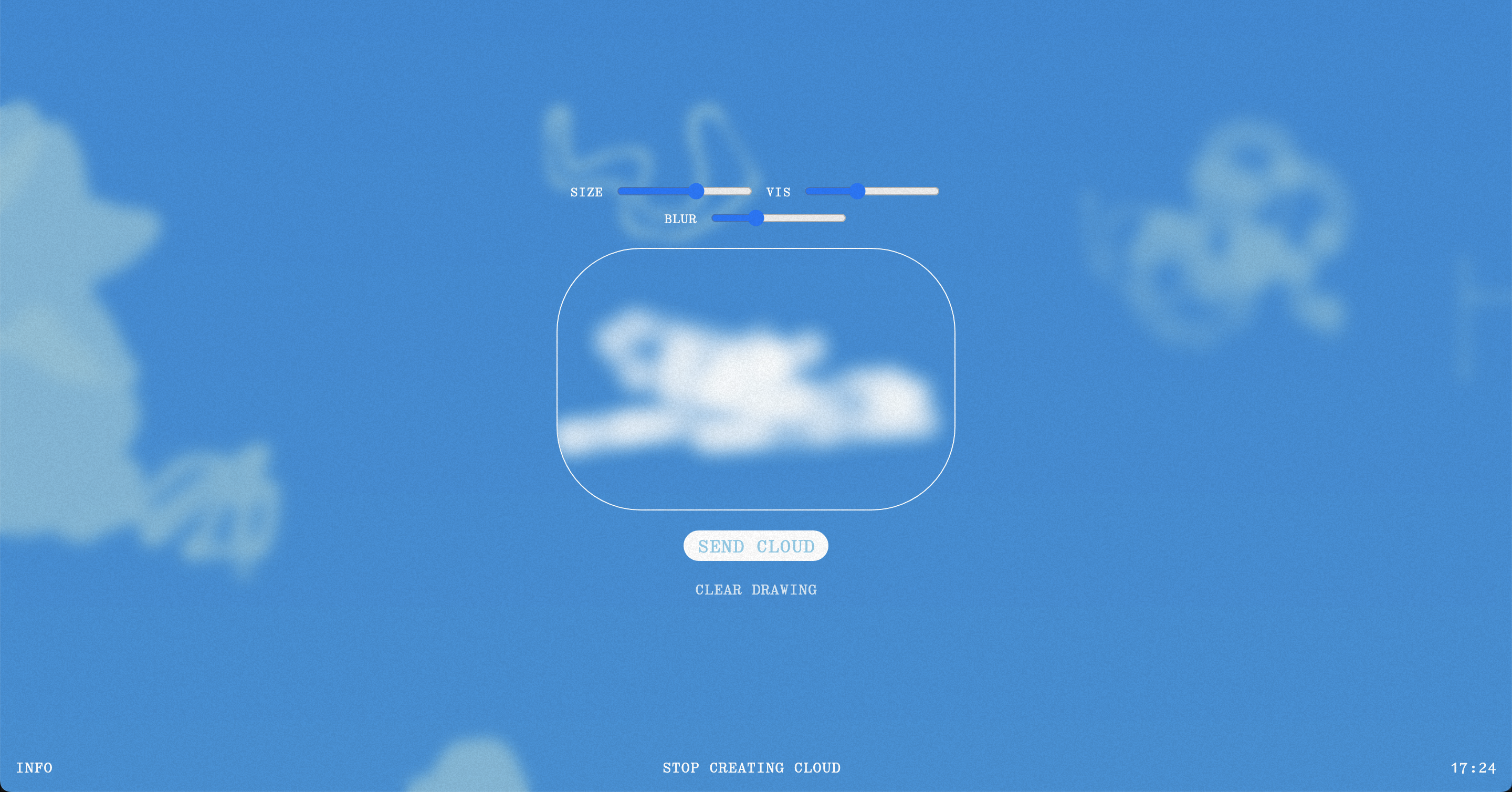

Cloudwatching by Chia Amisola
This website is called Cloudwatching, by internet artist Chia Amisola, when users first enter the site, they will first encounter drawings that look like clouds 'drifting' from left to right. These are drawings of users who have used this site and contributed to the web space. Cloudwatching is part of Chia Amisola's dating simulator that she is currently developing.

Client and Server
Client: This is like the "user" or the device you're using. It could be your phone, laptop, or computer. When you open a website or an app, you're the client.
Server: This is like the "helper" that holds all the information. When you ask the client (your phone or computer) for something, the server is where the actual data is stored. It sends that data back to you when you need it.
So, in simple terms:
The client asks for things (like a website).
The server gives the things the client asks for.
Frontend: This is everything that you can see and interact with when you use a website or app. It’s like the front of a store – the design, buttons, images, and text. If you click something or type something, you’re interacting with the frontend.
Backend: This is everything behind the scenes that you don’t see. It's where the data is stored, processed, and where the server is doing all the work to make the frontend work. It's like the stockroom in a store – it’s not visible, but it makes sure the store (the frontend) has everything you need.
GET and POST
GET: This is a way for the client (your browser or app) to ask the server for something. For example, when you visit a website, your browser sends a GET request to the server, asking for the page or information to show you.
POST: This is a way for the client to send data to the server. For example, when you fill out a form (like a signup form), you’re sending information to the server using POST. It’s like giving the server a new piece of information to save.
Database
Database: Imagine this as a giant digital filing cabinet where all the data (information) is stored. Servers use databases to organize, find, and manage the data. For example, a website that shows movies might have a database to store all the movie titles, descriptions, and ratings.
So, when you visit a website, the server might get data from a database to show you a list of movies. If you submit a review, it will POST that review to the server, which will save it in the database for future visitors to see.
Concept & Form of Website
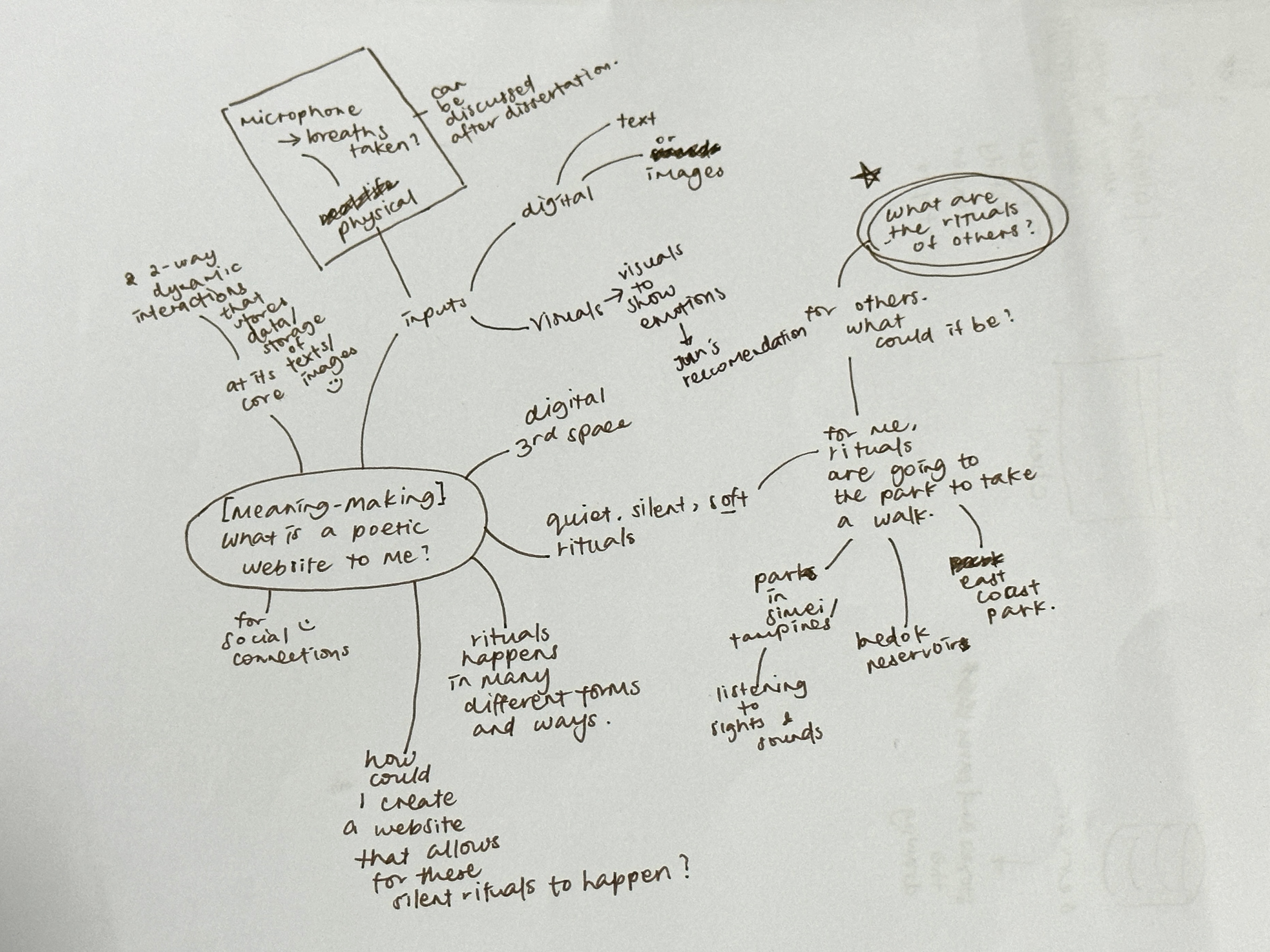

This website acts as a digital third space, for internet users to engage in a website that feels abit slower, rather than fast and overwhelming.
Quiet Rituals makes users think about how we interact on the internet and our online behaviours, especially how the
internet feels fast and overwhelming. It focuses on 'slower' digital experiences, enabling spaces that give us space
to pause, reflect, rather than just consume or do things quickly. It incorporates the idea of 'slow technology', a philosophy
aimed at supporting experiences of reflection through and on technology in everyday life.
Ideating this website idea was rather intuitive. I reflected on calming spaces in real life which I could use as a metaphor
to translate into a digital space for users to engage in. I thought about how would people think of rituals - and how would they
create them digitally.
Website or Internet Art?
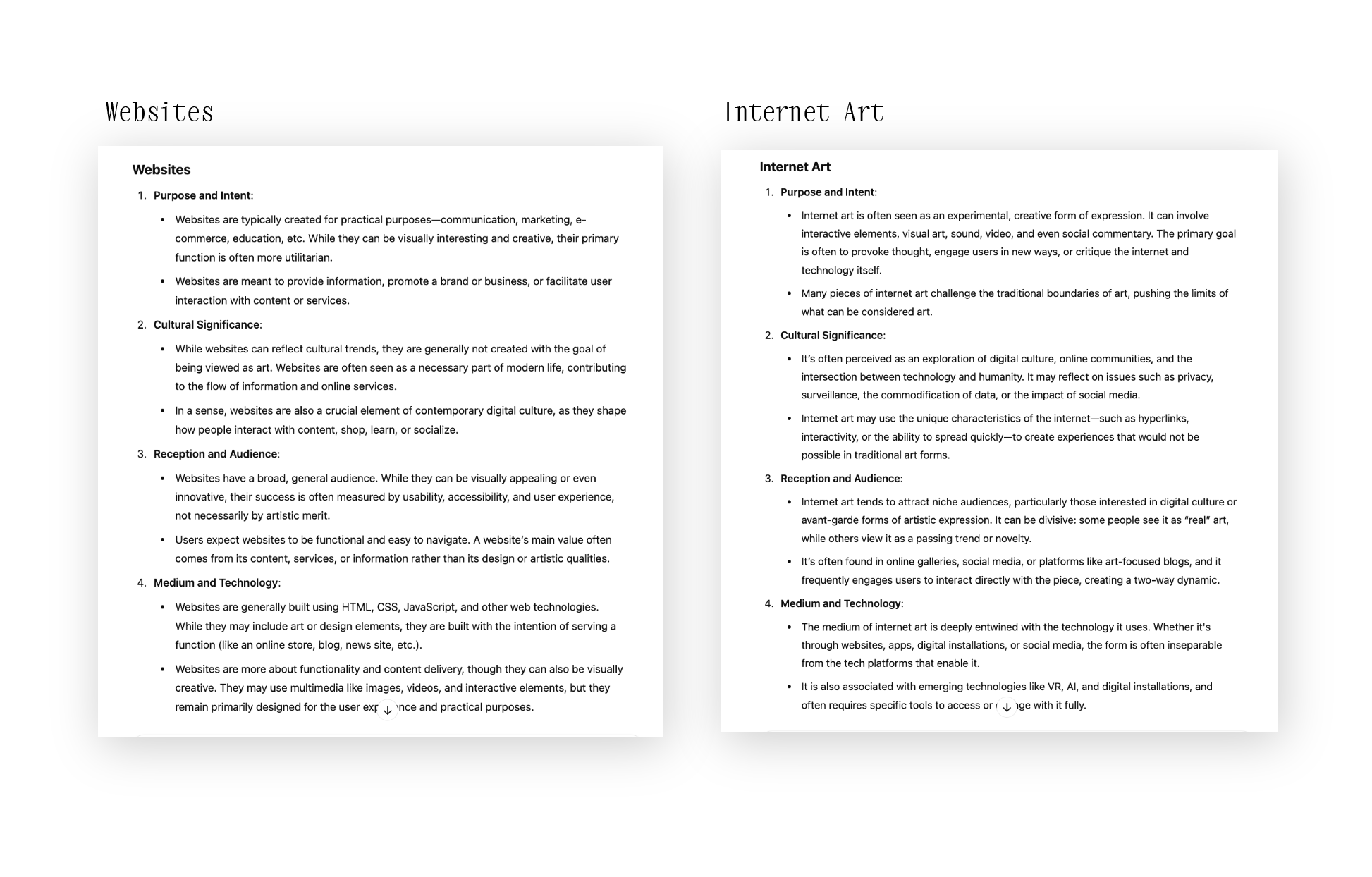
Reading up more about the community that I'm currently getting all my sources from, I find that I might struggle to communicate this project to a general/design audience. When I use the term web, or poetic web, I hope it sticks and is more palatable to the audience who doesn't know what my project is about. To establish the difference where my project stands, I chatgpt-ed the general perception of websites vs internet art. In general, I would assume that Internet Art is more cultural, creative, and experimental, rather than the perception of Websites, which are generally viewed as functional, everyday tools for accessing and disseminating information. I would stick to using the word Websites or Poetic Web more to describe as I think it's more palatable for designers or to a general audience.