Week 3
Research Update
From the first two weeks of research, I was still looking at incorporating living materials, mainly looking at Symbiotic Culture of Bacteria and Yeast (SCOBY), Mycelium and Algae. However, there were many things to consider, mainly, the growth process (which can take up to 3-4 weeks), stabilisation period and further textural experimentations. Re-evalutating my strengths and weaknesses, I decided to forgo experimenting with live materials and move on to other things.
Critical Journal Framework seminar with Gideon
The seminar we had with Gideon helped to give more insight into what I plan to do. A critical journal is developed around one’s own practice. It is iterative, where ideas (thinking) and production (making) are connected through the acquisition and application of knowledge. At this stage of my research, I think I am still eagerly trying to find outcomes, and readings that support this imaginary outcome. From this seminar, I would have to rethink the way I approach this. My research should be first-person observations, accounts and reflections that are also supported or added on by external sources. It is important to think of it holistically, so that we learn the essence of designing with context.
Thinking about the Web and Interactions
-
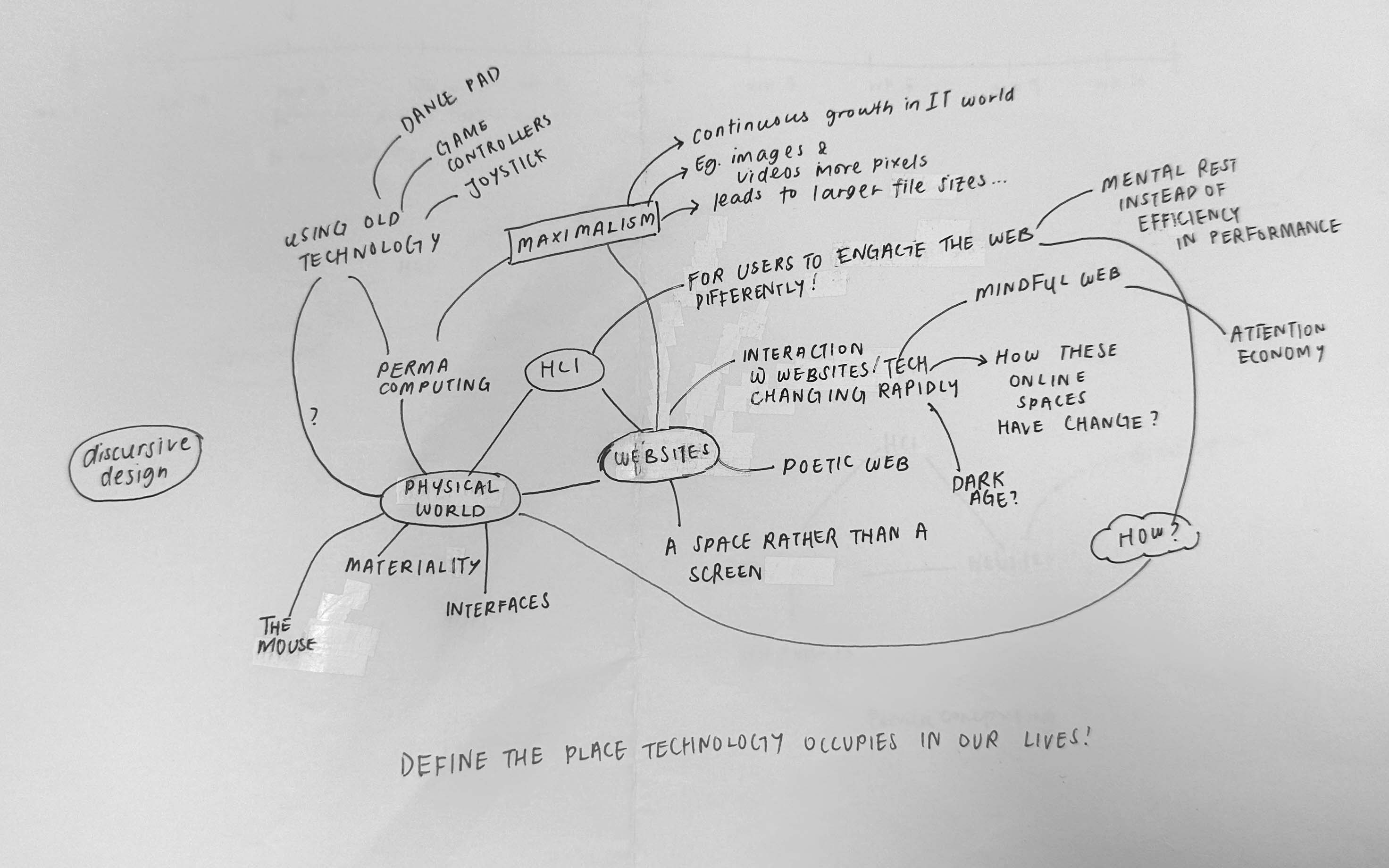
Mindmap 01 The first of many mindmaps to come.
Moving away from biodesign, I drew up a mind map, which briefly shows my limited knowledge of websites, and the physicality of everything… But I do know that there is a problem and there is something I want to work on.
During consultation with Andreas, I slowly gained more clarity on what each term meant. For example, I have been using the term materiality, when I meant interfaces instead. Andreas provided me with more interesting links to research on.
School for Poetic Computation
-
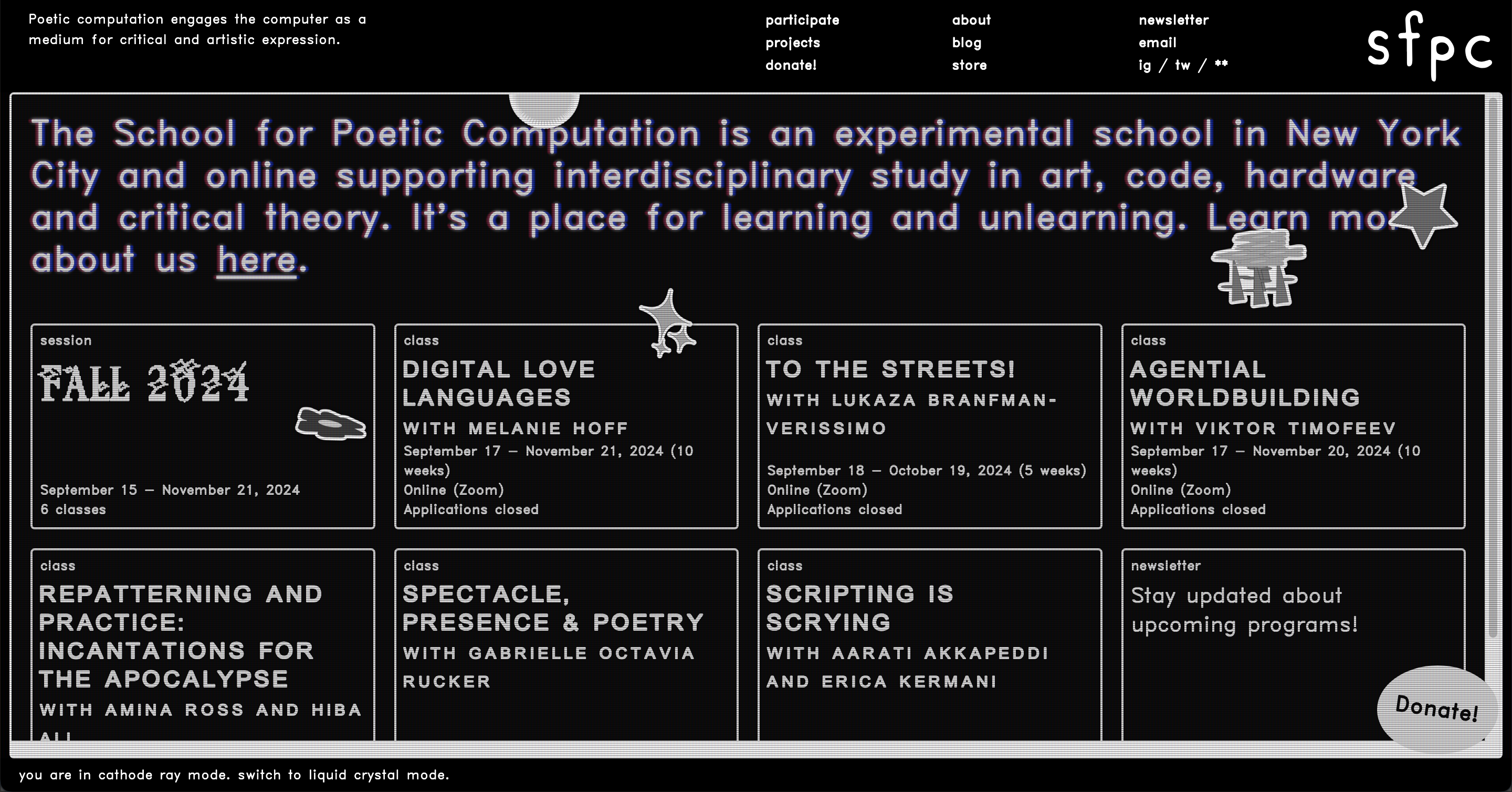
School For Poetic Computation An experimental school based in New York City.
The School For Poetic Computation is an experimental school and the main term 'Poetic Computation' is constantly defined and redefined by them. Aside from the super cool website which allows for both dark and light mode, the school mainly engages the computer as a medium for critical and artistic expression. It also looks at technology as a tool to be used for critical thinking and aesthetic inquiry.
Dreaming of a Poetic Web
Looking more into the SFPC Website, I found this project titled Dreaming of a Poetic Web which intrigued me since it was talking about the web. I feel like the problem identified was similar to my initial inquiry of the web being homogenous.
-

꘏ ु[the RVER] ु꘏ by The Jehovas. Explore the web with clickable objects and figures.
Problem The problem revolves around current web development practices, user expectations, and profit-oriented motivations that have made websites highly commercialised, and these are the common websites that we engage on a daily basis on the internet.
Approach/Methods Thereafter, they provided an approach, which is learning the core components (HTML, CSS and Javascript) of building websites, and studied experimental, handmade, and self-published websites that breaks those rules and challenge our preconceptions of what a "good" website should be.
Outcome Through understanding these, they then made websites that were purposefully unusable, ugly, and bad. Inspired by artist Chia Amisola, they relook at making websites as an act of caring for the self.
Thinking through Design Throughout the weeks, these students explored interactive possibilities of websites and found that websites can be a medium for them to understand and express their own changing and healing journeys. Subsequently, learning that these websites are capable of connecting them and asking them to be present.
I think I would have to be more specific my research with the web. Currently, I have only conceptualised that websites have become homogenous compared to early web, then I also thought about how websites are designed to constantly grab our attention (attention economy), and how I think users should have more awareness and intention when browsing the web. I would read up more on the different ways people list problems of the web and then narrow down on my research subsequently.
Feelers Feelers
The next thing that Andreas recommended me to research is Feelers Feelers which is a art, design and technology research lab based in Singapore.
-

Projects by Feelers. Diverse Range of computational outcomes.
Researching about Feelers got me really inspired, as they are able to have a wide variety of outcomes based on the research that they do for various topics about tech. The visuals and concepts makes issues and the tech industry easier to comprehend.
One thing I really appreciate is the informative yet fun visuals they incorporate into their works which are documented on Instagram. I feel like it's extremely hard to strike that balance, yet Feelers does that so well.
I would take inspiration from their projects and looking out for the ways they approach deep topics of technology.
There are 2 other recommended things that I would like to research further later on, such as School of Machines and Net Art.
The Toaster Project
-
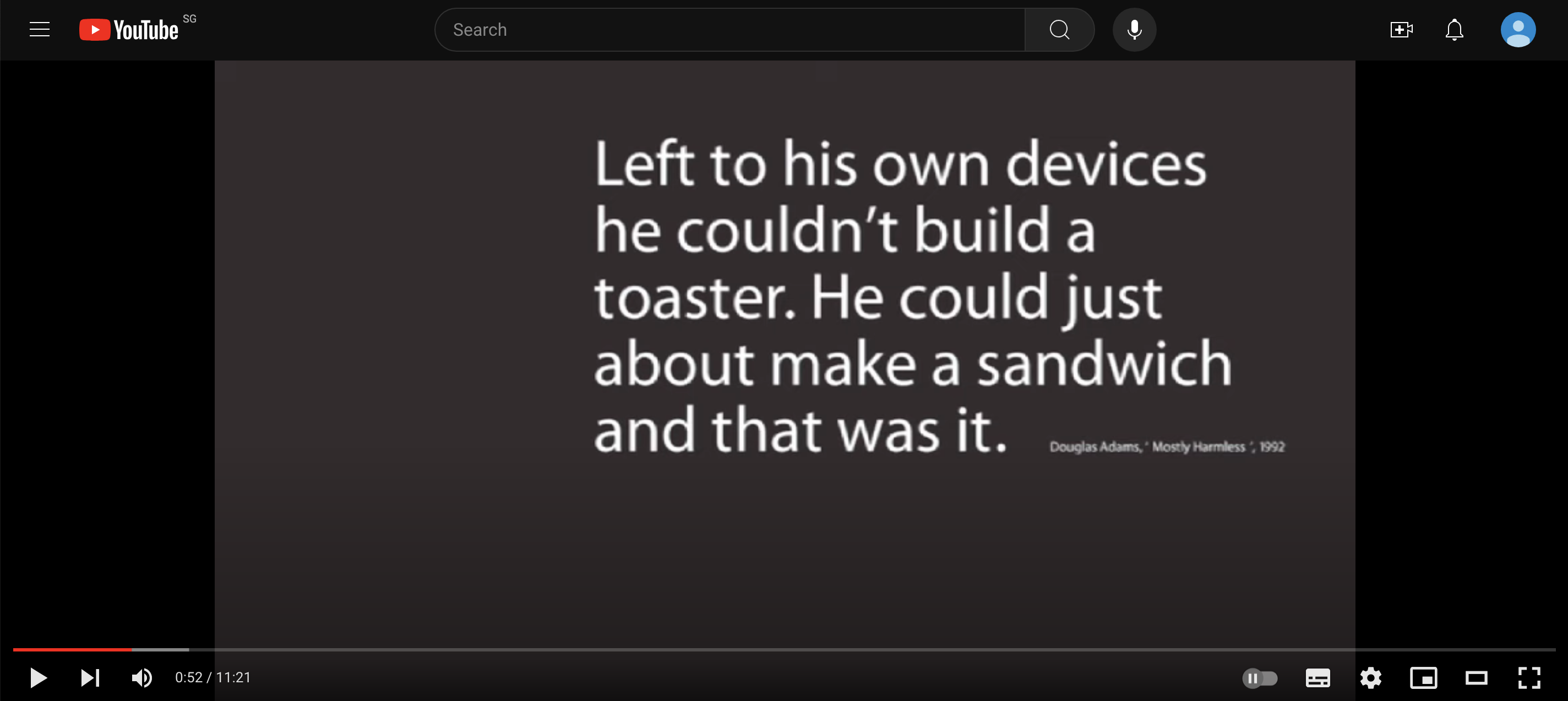
How I built a toaster from scratch by Thomas Thwaites
I remembered Vikas recommended reading about the the Toaster project, in reference to how learning can occur through making in design.
I didn’t read the book - but I watched the TED talk. This quote resonated with me: “The smaller the scale you want to work on, the further back in time you have to go.” (Timestamp: 4:30) This was in reference to the part where he needed to get iron, and couldn’t find a step-by-step tutorial on metallurgy.
This shed light on the way we collectively look at things, especially with how we are so used to quickly consuming things and throwing away after a few uses. It also shows how our fast-paced, consumption-driven culture often overlooks the intricate layers of history, craft and care embedded in things.
Linking to the web,
this fast-paced culture did not escape the way websites have become too. In the earlier days, there was more craft and attention to building the code of a website, and this pushed for creativity more than utilitarianism of a website. On top of that, the way that social media apps are designed are geared towards capturing momentary attention. For eg, short-form videos and ephemeral content. It is increasingly harder to foster deeper connections and thoughtfulness when browsing the web.